
OUR SERVICES
What is Advanced Wound Care?
Advanced wound care is provided by specially trained medical experts who perform thorough assessments and aggressive treatments of chronic and complicated non healing wounds.
We utilize the T.I.M.E. principle to address the fundamentals of non healing wounds.
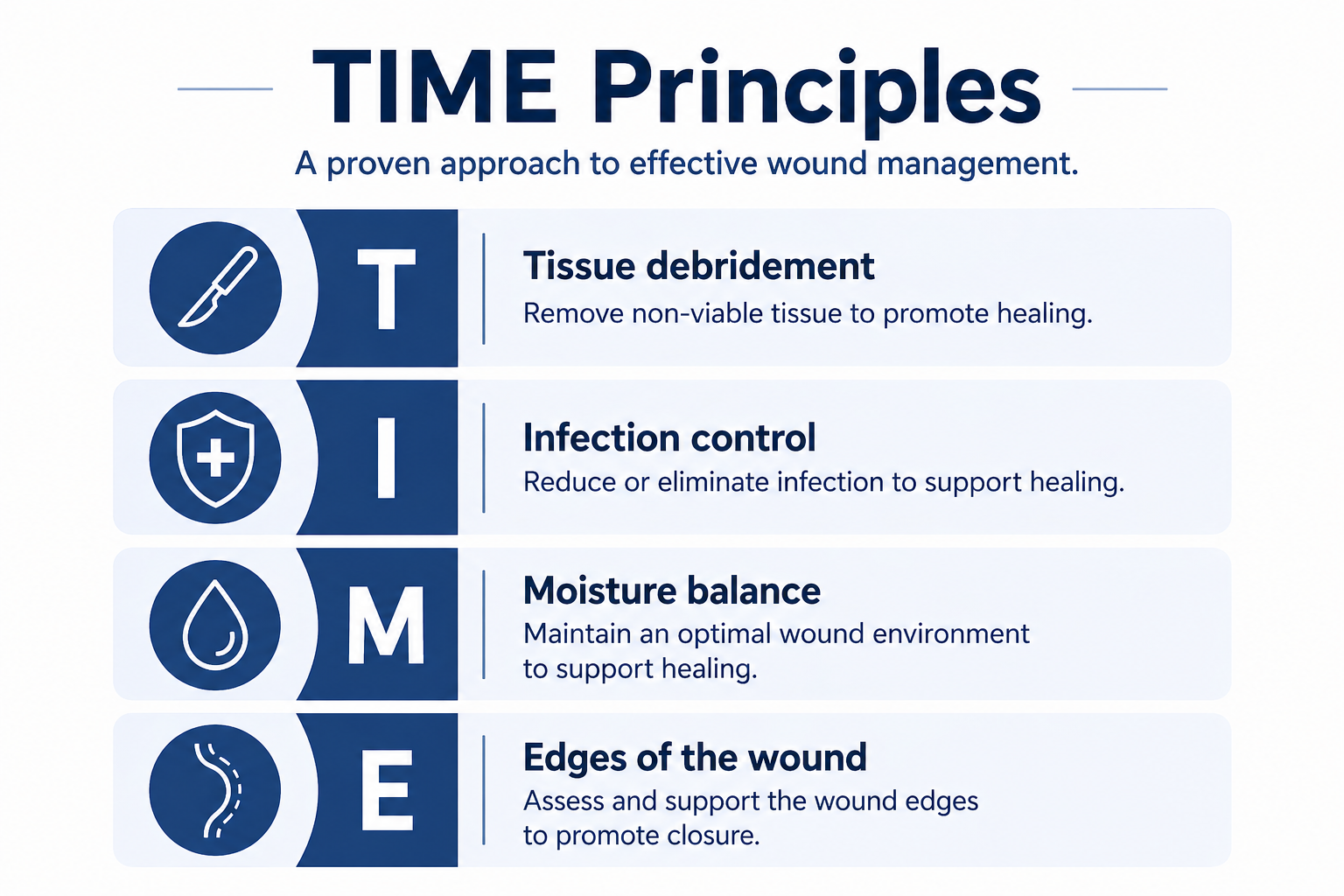
* Treatment is then customized to the ulcer type.
Chronic wounds often arise due to underlying, complex conditions such as diabetes, poor circulation, or immune system issues, making specialized care essential.
Why Do We Need Advanced Wound Care?
Non-healing wounds can lead to severe consequences, including infections, which can sometimes become life-threatening.
If a chronic wound remains untreated, the risk of infection escalates, potentially leading to systemic complications or even sepsis.
Furthermore, untreated wounds can result in tissue loss and, in extreme cases, necessitate amputation.
The physical and emotional toll of such outcomes underscores the importance of timely and effective wound care.
Early intervention saves limbs and it saves lives.
What Sets Us Apart
Our approach goes beyond merely treating the wound; we focus on understanding the complex nature of chronic wounds.
At Western MA Wound Care, we take a holistic approach to treatment, recognizing that effective wound healing requires a comprehensive understanding of your unique medical history, lifestyle, and specific wound characteristics.
This holistic perspective is pivotal in crafting personalized care plans that address the root causes of chronic wounds, rather than just the symptoms.
What Kind of Wounds Need Advanced Wound Care?
Any wounds that have not resolved within 30 days or are otherwise not progressing appropriately in their healing should be evaluated by an Advanced Wound Care Expert as soon as possible.
This includes:
New wounds on the lower legs, feet, or toes of people who have known medical conditions such as diabetes, cardiovascular disease, including peripheral arterial disease and Venous Insufficiency, neuropathy, paralysis/paraplegia
Wounds that are getting larger or worsening
Surgical wounds that have dehisced or never closed
Deep wounds not repairable with sutures
First and Second degree burns
Our goal is to accelerate healing so you can return to your daily life with confidence.
We offer both standard and advanced therapies designed to stimulate healing—especially when traditional treatments have fallen short.

Common Wounds We Treat
Diabetic Ulcer: Occurs in people with diabetes, often painless due to neuropathy, commonly found on the foot, heel, or toes.
Arterial Ulcer: Caused by poor blood flow, typically found on the lower legs, feet, or toes, and often very painful, especially at rest or at night.
Venous Ulcer: Develops on the inner lower leg (gaiter region), associated with swelling and venous insufficiency, and can result from minor injury.
Pressure Ulcer: Forms from prolonged pressure over bony areas, common in bed- or wheelchair-bound patients, often found on the sacrum, heels, or feet.